The universe contains some of the most mysterious and powerful objects ever discovered, and black holes stand at the center of that mystery. Among the most fascinating astronomical phenomena are black holes consuming stars, a dramatic process where a star gets pulled apart by the intense gravity of a black hole. These violent interactions release enormous amounts of energy and light, making them some of the brightest and most terrifying cosmic events observed in space.
Modern telescopes and advanced research technology have allowed scientists to witness several examples of black holes consuming stars in distant galaxies. These rare observations have become major milestones in recent space discoveries because they provide important clues about gravity, galaxy formation, and the behavior of matter under extreme conditions. The destruction of stars by black holes may sound like science fiction, but it is a real process that helps scientists better understand how the universe works.
What Happens When Black Holes Consume Stars
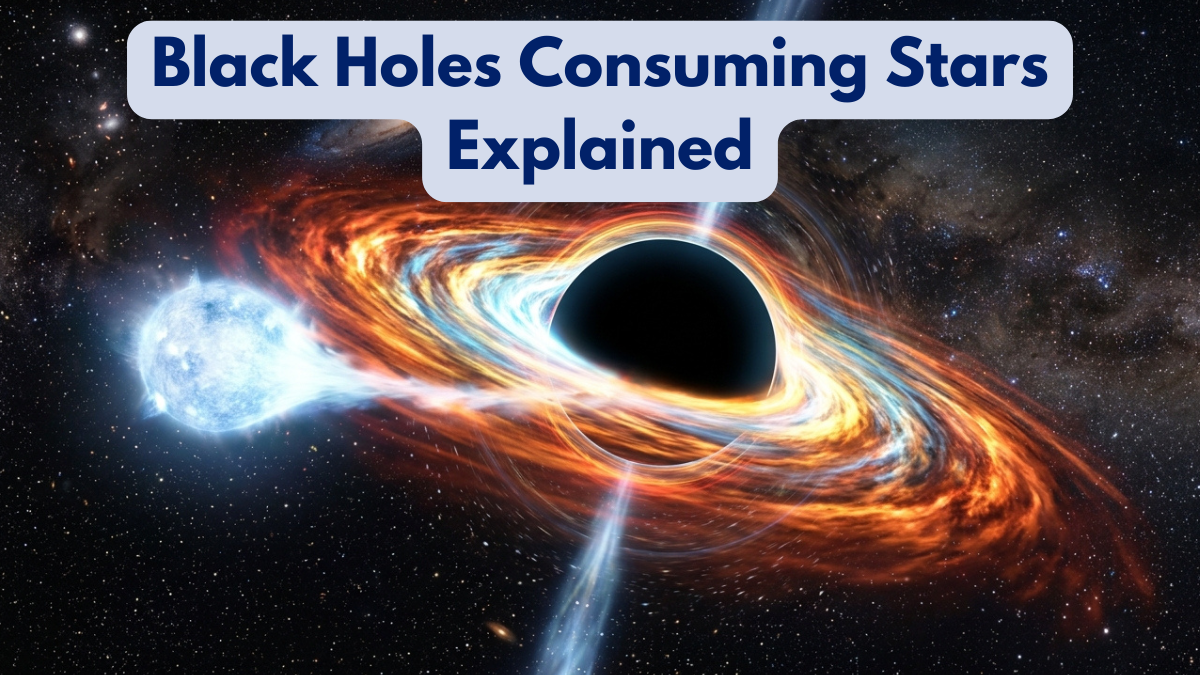
The process behind black holes consuming stars usually begins when a star travels too close to a black hole. Black holes possess gravity so strong that nothing can escape once it crosses a boundary called the event horizon. Before reaching that point, however, the star experiences extreme stretching forces caused by gravity differences across its structure.
Scientists refer to this process as a tidal disruption event. During these dramatic cosmic events, the star becomes stretched into long streams of gas and matter. Some material gets pulled directly into the black hole, while other debris is launched into surrounding space at incredible speeds.
Researchers studying space discoveries often compare the process to spaghetti being stretched apart. This effect is sometimes called “spaghettification.” The intense heat and friction generated during the event produce powerful radiation that can be detected by telescopes across vast distances.
Important stages involved in black holes consuming stars include:
- A star approaches the black hole
- Gravitational forces stretch the star
- The star breaks apart into gas streams
- Material forms an accretion disk
- The black hole absorbs stellar matter
These powerful cosmic events are among the most energetic phenomena in the observable universe.
Different Types of Black Holes in the Universe
Understanding black holes consuming stars also requires knowing that black holes come in different sizes and categories. Some are only a few times larger than the Sun, while others contain billions of solar masses.
Here is a table showing the major types of black holes:
| Type of Black Hole | Estimated Size | Formation Method |
|---|---|---|
| Stellar Black Hole | 5–100 solar masses | Collapse of massive stars |
| Intermediate Black Hole | Hundreds to thousands of solar masses | Merging stellar black holes |
| Supermassive Black Hole | Millions to billions of solar masses | Found at galaxy centers |
| Primordial Black Hole | Hypothetical tiny black holes | Early universe formation |
Most observed examples of black holes consuming stars involve supermassive black holes located at the centers of galaxies. These enormous objects dominate their surrounding environments through extreme gravity.
Recent space discoveries suggest nearly every large galaxy may contain a supermassive black hole at its core. Scientists continue studying how these objects grow and influence galactic evolution through massive cosmic events.
How Scientists Detect Black Holes Consuming Stars
Black holes themselves cannot be seen directly because they do not emit light. However, scientists can observe the effects caused by black holes consuming stars. When stellar material falls toward a black hole, it heats up to millions of degrees and releases enormous radiation.
Astronomers use specialized telescopes to detect X-rays, ultraviolet light, and radio signals produced during these cosmic events. Space observatories such as NASA’s Chandra X-ray Observatory and the James Webb Space Telescope have significantly improved the study of black hole activity.
Some signs scientists look for include:
- Sudden bursts of bright light
- Intense X-ray emissions
- Expanding clouds of gas
- High-speed jets of particles
- Changes in nearby stars’ movement
These observations have led to major space discoveries regarding galaxy behavior, gravity, and extreme astrophysical environments. Every new case of black holes consuming stars provides valuable information about how matter behaves near intense gravitational fields.
Why Black Holes Are So Powerful
The incredible power behind black holes consuming stars comes from gravity. Black holes form when massive stars collapse under their own weight after exhausting nuclear fuel. The remaining core becomes compressed into an extremely dense object where gravity becomes overwhelming.
The event horizon marks the point where escape becomes impossible. Beyond this boundary, not even light can escape the black hole’s pull. Scientists continue studying these regions because they challenge current understanding of physics.
Many researchers involved in modern space discoveries believe black holes may help reveal connections between gravity, quantum mechanics, and the structure of space-time itself. These extreme cosmic events provide natural laboratories for testing theories about the universe.
Interesting black hole characteristics include:
- Gravity bends light around them
- Time slows near intense gravity
- They can merge and create gravitational waves
- Some eject powerful particle jets
- They influence galaxy formation
The study of black holes consuming stars continues revealing how powerful and dynamic the universe truly is.
Recent Space Discoveries About Black Holes
Advances in astronomy have dramatically increased understanding of black holes consuming stars over the last decade. Scientists recently captured the first image of a black hole shadow using the Event Horizon Telescope, marking one of the biggest space discoveries in modern science.
Researchers have also observed black holes releasing enormous energy jets while consuming nearby matter. Some black holes rotate at incredible speeds, affecting surrounding gas and magnetic fields.
New observations suggest that cosmic events involving black holes may influence star formation inside galaxies. In some cases, black hole activity may even regulate galactic growth by heating surrounding gas and preventing new stars from forming too quickly.
Recent discoveries related to black holes consuming stars include:
- Detection of tidal disruption events
- Observation of black hole mergers
- Discovery of rapidly spinning black holes
- Evidence of intermediate black holes
- Measurement of gravitational waves
These findings continue transforming scientific understanding of the universe and the role black holes play in cosmic evolution.
Could Black Holes Threaten Earth?
Many people fear the idea of black holes consuming stars, but scientists say Earth faces no immediate danger from known black holes. The nearest known black holes are far too distant to affect the Solar System directly.
Supermassive black holes exist mainly at galaxy centers, including Sagittarius A* at the center of the Milky Way. Fortunately, Earth is located safely far from this region. While cosmic events involving black holes can be incredibly destructive locally, their effects weaken greatly across vast distances.
Scientists involved in space discoveries continue monitoring black holes primarily for research purposes rather than planetary defense concerns. Understanding black holes helps researchers better explain the origins and future behavior of galaxies across the universe.
Conclusion
The mystery of black holes consuming stars represents one of the most dramatic and fascinating processes in astronomy. These enormous gravitational objects can rip stars apart, release incredible energy, and reshape surrounding regions of space during powerful cosmic events.
Modern space discoveries have allowed scientists to observe black holes more closely than ever before, revealing important details about gravity, galaxy formation, and the extreme physics governing the universe. Every new observation brings humanity closer to understanding these mysterious cosmic giants.
As technology continues advancing, future research into black holes consuming stars will likely uncover even more astonishing secrets hidden within the depths of space.
FAQs
What happens when a black hole consumes a star?
When a star gets too close to a black hole, intense gravity tears it apart in a tidal disruption event, causing stellar material to spiral into the black hole.
Can black holes destroy entire galaxies?
Black holes can influence galaxy structure and star formation, but they do not usually destroy entire galaxies completely.
How do scientists detect black holes?
Scientists detect black holes by observing radiation, X-rays, and gravitational effects produced by surrounding matter and nearby stars.
Are black holes dangerous to Earth?
Known black holes are far too distant to pose any direct threat to Earth or the Solar System.
Why are black holes important in space discoveries?
Black holes help scientists study gravity, galaxy evolution, space-time physics, and extreme cosmic environments.
Click here to learn more