Time is something we experience every day, yet its organization across the world is more complex than it seems. One of the most important questions people ask is why countries have time zones and how this system came into existence. Without time zones, coordinating activities across different regions would be chaotic, especially in a world that depends heavily on communication and travel.
The concept is deeply connected to the global time system, which was developed to bring consistency and order to timekeeping. It is also influenced by geography rules, as the Earth’s rotation and position relative to the sun play a key role in determining local time. Understanding the origin and importance of time zones helps explain how modern societies function efficiently on a global scale.
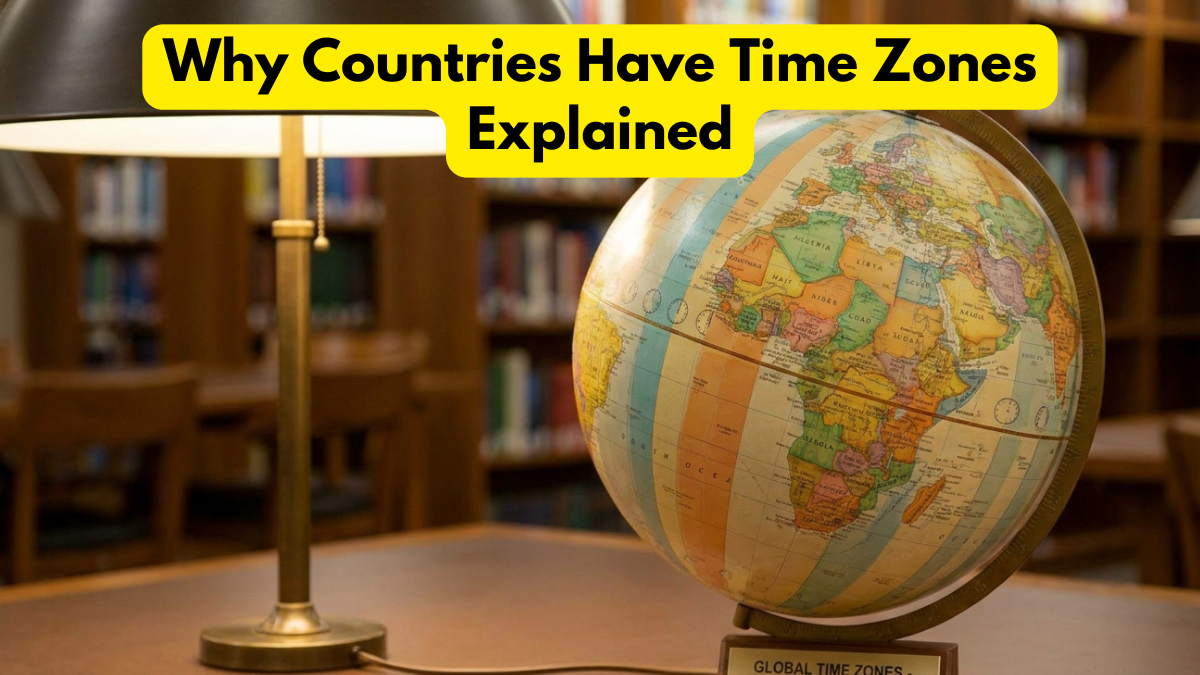
Early Timekeeping and Local Time
To understand why countries have time zones, we must look at how time was measured before standardization. In the past, each city or town followed its own local time based on the position of the sun. Noon was simply when the sun was at its highest point in the sky.
This system worked when travel was slow, but it became problematic with the rise of railways and faster transportation. The lack of a unified global time system caused confusion in scheduling and coordination. This period in history highlights the need for consistent geography rules to manage time effectively.
Key characteristics of early timekeeping include:
- Local time based on solar position
- Differences between nearby regions
- Lack of synchronization across cities
- Increasing confusion with technological progress
These challenges set the stage for the development of standardized time zones.
Introduction of Standard Time Zones
The modern explanation for why countries have time zones begins in the 19th century with the expansion of railways. Railway companies needed a consistent schedule to avoid confusion and accidents, leading to the creation of standardized time zones.
In 1884, the International Meridian Conference established the Prime Meridian at Greenwich, England, as the reference point for the global time system. The world was divided into 24 time zones, each representing one hour of the Earth’s rotation.
Important developments include:
- Adoption of Greenwich Mean Time (GMT)
- Division of the Earth into 24 time zones
- Standardization of time across regions
- Alignment with natural geography rules
These changes made it easier to coordinate travel, communication, and trade on a global scale.
Structure of the Global Time System
The global time system is designed to reflect the Earth’s rotation, with each time zone covering approximately 15 degrees of longitude. This ensures that local time aligns closely with daylight hours.
Below is a table summarizing the structure of time zones:
| Time Zone | Offset from GMT | Example Region |
|---|---|---|
| GMT (0) | 0 hours | United Kingdom |
| GMT+1 | +1 hour | Central Europe |
| GMT+5:30 | +5.5 hours | India |
| GMT-5 | -5 hours | Eastern USA |
| GMT+10 | +10 hours | Australia |
This system demonstrates why countries have time zones, as it allows different regions to maintain time that corresponds to their geographical position. The use of geography rules ensures that daylight and human activity remain aligned.
Importance of Time Zones in Modern Life
Today, the question of why countries have time zones is more relevant than ever. Time zones play a crucial role in global communication, travel, and business operations. Without them, coordinating international activities would be extremely difficult.
The global time system allows people in different parts of the world to work together efficiently. For example, businesses can schedule meetings across continents, and airlines can manage flights accurately.
In modern geography rules, time zones also account for political and social factors. Some countries adjust their time zones to suit economic or cultural needs, showing that the system is both scientific and flexible.
Key benefits of time zones include:
- Improved coordination of global activities
- Efficient transportation scheduling
- Better alignment with natural daylight
- Simplified international communication
These advantages highlight the importance of time zones in maintaining order in a connected world.
Conclusion
The explanation of why countries have time zones lies in the need for consistency, efficiency, and alignment with the Earth’s natural cycles. From local solar time to a standardized global time system, the evolution of timekeeping reflects humanity’s ability to adapt to changing needs.
The role of geography rules ensures that time zones remain connected to the Earth’s rotation, providing a logical and practical framework for managing time. This system has become an essential part of modern life, enabling global connectivity and coordination.
In conclusion, time zones are not just a technical system but a fundamental aspect of how the world operates. Their development has made it possible for societies to function smoothly, proving the importance of structured timekeeping in a globalized era.
FAQs
Why do countries have time zones
Why countries have time zones is to ensure consistent timekeeping based on the Earth’s rotation and geographical position.
What is the global time system
The global time system is a standardized method of dividing the world into time zones for better coordination.
How many time zones are there
There are 24 main time zones, each representing one hour of the Earth’s rotation.
Why is GMT important
GMT serves as the reference point for the global time system and helps define time zones worldwide.
Do all countries follow the same time zone rules
Not always, as some countries adjust their time zones based on political or cultural geography rules.
Click here to learn more