As our dependence on technology grows, space weather forecasting has become more important than ever. Satellites power global communication, navigation, climate monitoring, and countless everyday services. However, these systems face ongoing threats from solar flares, geomagnetic storms, and other cosmic disturbances. Without proper forecasting, satellites can malfunction or become permanently damaged. This makes satellite protection a critical priority for scientists, engineers, and space agencies. Understanding and predicting space weather allows experts to take preventive action and minimize the risks associated with these powerful natural events.
Understanding Space Weather and Its Impact on Satellites
Space weather refers to conditions in the solar system, particularly those caused by the Sun’s activity. Events such as solar flares, coronal mass ejections, and high-energy particle storms can disrupt satellite operations. Space weather forecasting helps scientists determine when these events might occur and how severe they may be.
These predictions are essential for satellite protection because space weather can interfere with electronic components, weaken satellite structures, and cause navigational errors. The growing number of satellites in orbit makes accurate forecasting crucial for maintaining global technological stability.
Tools and Techniques Used in Space Weather Forecasting
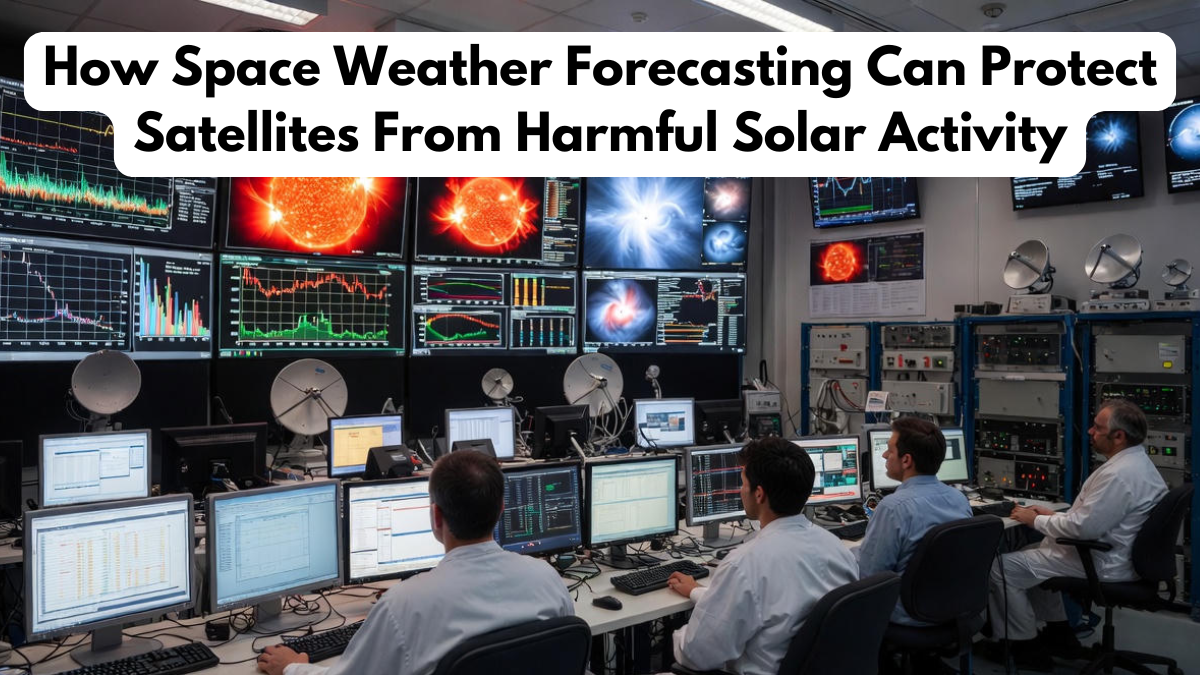
Space agencies around the world use advanced tools to observe and analyze solar activity. This includes ground-based telescopes, space observatories, and magnetic field detectors. With these technologies, researchers can monitor the Sun’s behavior and identify signs of upcoming disturbances that may affect satellites.
This sophisticated approach to space weather forecasting directly supports satellite protection by allowing engineers to activate safety protocols. Below is a table outlining key tools used in monitoring and predicting space weather:
| Forecasting Tool | Function | Contribution to Satellite Protection |
|---|---|---|
| Solar Telescopes | Observe sunspots and solar flares | Detect early warnings of harmful solar activity |
| Space Probes | Measure solar wind particles | Help anticipate geomagnetic storms |
| Magnetometers | Track Earth’s magnetic field | Identify stress on satellite systems |
| Radiation Sensors | Monitor cosmic radiation levels | Assess risk to satellite electronics |
| Computational Models | Predict solar storm intensity | Improve planning and emergency responses |
Through these tools, forecasting becomes more precise, enabling better readiness and long-term mission safety.
How Forecasting Protects Satellites From Harm
One of the greatest advantages of space weather forecasting is that it gives satellite operators time to prepare for incoming solar disturbances. When a forecast reveals potentially harmful conditions, space agencies can place satellites in safe mode, adjust their orbits, or temporarily shut down sensitive systems.
These proactive steps significantly improve satellite protection, reducing the risk of permanent damage. Forecasting also aids industries dependent on satellite systems, such as aviation, telecommunications, banking, and global navigation. With reliable warnings, these industries can adjust operations to avoid disruptions caused by space weather.
The Growing Importance of Space Weather Prediction in a Digital Age
With more satellites being launched each year, the importance of space weather forecasting continues to rise. Modern society depends heavily on satellite-supported services, and a single major solar event could disrupt communication, power grids, and transportation systems. This growing vulnerability pushes scientists to develop more accurate forecasting tools.
Enhancing satellite protection ensures that our expanding network of space-based technologies remains resilient. Governments, private companies, and research organizations worldwide are investing in advanced monitoring systems and international collaboration to strengthen global preparedness.
Conclusion
As humanity becomes increasingly reliant on satellite technology, the role of space weather forecasting grows ever more essential. Accurate predictions allow scientists and engineers to safeguard satellites against harmful solar activity, ensuring the continuity of vital global services. Through enhanced monitoring tools, better modeling techniques, and coordinated international efforts, satellite protection continues to advance. The future of space technology depends on our ability to anticipate and respond to the dynamic forces of space weather.
FAQs
What is the purpose of space weather forecasting?
It helps predict solar activity that could disrupt satellites, enabling effective satellite protection measures.
How does solar activity damage satellites?
Solar flares and particle storms can overload satellite electronics and interfere with communication systems.
Can forecasting prevent satellite failures?
Yes, accurate space weather forecasting allows operators to place satellites into safe modes before storms hit.
Why is satellite protection increasingly important?
Because modern communication, navigation, and data systems rely heavily on satellites exposed to space weather.
What tools help predict space weather?
Solar telescopes, space probes, magnetometers, and advanced models all support reliable space weather forecasting.
Click here to learn more