High above Earth’s atmosphere, invisible forces constantly shape the technological systems that modern civilization depends upon. The growing concern surrounding space weather effects is no longer limited to scientists and engineers; it now affects governments, industries, and everyday life. Solar radiation, magnetic disturbances, and charged particles travel across millions of kilometers, interacting with Earth’s protective shield in powerful ways. When these forces intensify, they create disruptions that can damage satellites, interfere with navigation, and destabilize global communication networks.
The importance of understanding space weather effects becomes clearer with society’s increasing reliance on digital infrastructure. Everything from financial markets and aviation to emergency services and internet connectivity depends on reliable satellite systems. Events such as solar storms and heightened geomagnetic activity can weaken these systems, causing outages, data loss, and communication failures. As the number of satellites in orbit continues to rise, humanity’s vulnerability to these cosmic events grows significantly.
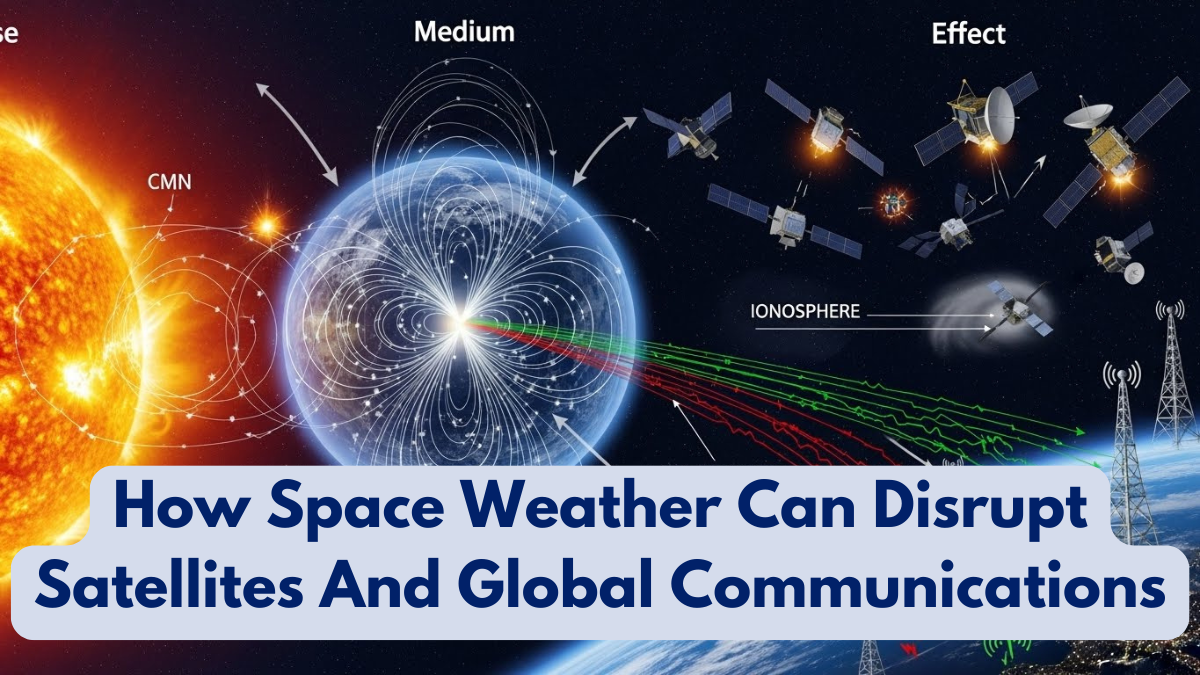
The Science Behind Space Weather
Space weather effects originate primarily from the Sun. Through explosive releases of energy known as solar storms, massive quantities of charged particles are launched into space. When these particles reach Earth, they interact with the planet’s magnetic field, producing intense geomagnetic activity. This interaction distorts the magnetosphere, inducing electrical currents in the upper atmosphere and across the planet’s surface.
These currents interfere with the electronic systems aboard satellites, causing signal delays, component failures, and sometimes complete satellite loss. During severe solar storms, navigation systems become unreliable, radio communications fade, and power grids experience surges. The increasing complexity of modern technology amplifies the impact of space weather effects, making even minor disturbances significant.
How Space Weather Disrupts Global Systems
Modern civilization depends heavily on satellites for navigation, communication, weather forecasting, banking, and military operations. Space weather effects threaten all these functions simultaneously. Heightened geomagnetic activity alters signal paths, leading to inaccurate GPS readings and disrupted telecommunications. Airlines reroute flights, shipping operations slow, and emergency response coordination weakens.
When powerful solar storms strike, high-energy particles penetrate satellite shielding, damaging onboard electronics. This reduces satellite lifespan and increases the risk of cascading failures across entire satellite constellations. The resulting disruptions illustrate why understanding space weather effects has become a top priority for space agencies and infrastructure planners worldwide.
Comparison of Normal and Severe Space Weather Conditions
| Factor | Normal Conditions | Severe Space Weather |
|---|---|---|
| Geomagnetic activity | Low | Extremely high |
| Satellites performance | Stable | Degraded or damaged |
| Communication reliability | High | Frequently disrupted |
| Navigation accuracy | Precise | Significantly reduced |
| Power grid stability | Normal | Vulnerable to surges |
| Risk from solar storms | Minimal | Critical |
This comparison demonstrates how severe space weather effects transform stable systems into vulnerable networks within hours.
Preparing for the Next Solar Event
Scientists continuously monitor solar activity to forecast potential space weather effects. Early warning systems track rising geomagnetic activity and approaching solar storms, allowing operators to place satellites into safe modes, reroute communication networks, and protect power grids. However, prediction remains challenging due to the complex behavior of the Sun and the vast distances involved.
Governments and private industries are now investing heavily in protective technologies. Satellite manufacturers enhance shielding, engineers design more resilient electronics, and grid operators strengthen infrastructure against geomagnetically induced currents. These measures aim to reduce the long-term risks of space weather effects, but complete immunity remains impossible.
Why Space Weather Matters More Than Ever
The modern world is more connected than at any point in history. Thousands of satellites orbit Earth, supporting everything from smartphone navigation to global commerce. This dependence makes humanity uniquely sensitive to space weather effects. A single extreme solar event could trigger widespread communication failures, economic losses, and social disruption on a scale rarely seen.
As space exploration expands and commercial satellite networks grow, the stakes continue to rise. Understanding space weather effects, anticipating solar storms, monitoring geomagnetic activity, and protecting satellites are now essential components of global security and economic stability.
Conclusion
The invisible forces of the cosmos hold immense power over modern civilization. Space weather effects, driven by solar storms and intensified geomagnetic activity, threaten the technological systems that keep the world running. As reliance on satellites deepens, safeguarding these systems becomes a global priority. Through research, preparedness, and resilient design, humanity can better withstand the challenges of space weather and protect the digital foundation of modern life.
FAQs
What causes space weather effects?
Space weather effects are primarily caused by solar storms and fluctuations in geomagnetic activity.
How do space weather effects impact satellites?
Charged particles and magnetic disturbances damage electronics and disrupt signals on satellites, reducing performance and reliability.
Can space weather affect daily life?
Yes. Space weather effects can disrupt GPS, communication networks, aviation routes, and power systems.
Are solar storms becoming more dangerous?
As dependence on satellites grows, the impact of solar storms and geomagnetic activity becomes more severe, even if storm frequency remains stable.
Click here to learn more