Prompt engineering careers have emerged as one of the fastest-growing professional paths in 2026 as artificial intelligence becomes embedded across nearly every industry. As organizations deploy large language models and generative AI systems at scale, the ability to communicate effectively with these systems has become a high-value capability. Prompt engineering careers focus on designing, refining, and optimizing prompts that guide AI outputs toward accurate, ethical, and business-relevant results. Unlike traditional technical roles, these positions blend creativity, logic, and contextual understanding, making them central to modern AI jobs. As companies prioritize adaptability and innovation, future skills like prompt engineering are redefining what it means to work with AI.
Understanding Prompt Engineering and Its Core Responsibilities
At its core, prompt engineering involves crafting structured inputs that influence how AI systems respond. Professionals in prompt engineering careers analyze how models interpret language, context, and constraints to produce desired outcomes. Responsibilities often include testing prompt variations, reducing bias, improving consistency, and aligning outputs with organizational goals. In many AI jobs, prompt engineers act as the bridge between technical AI teams and business stakeholders. This role requires an understanding of model behavior, domain expertise, and communication skills, making prompt engineering one of the most interdisciplinary future skills in the AI ecosystem.
Why Prompt Engineering Is Becoming Central to AI Jobs
As AI tools move beyond experimentation into mission-critical applications, the quality of prompts directly affects performance, safety, and reliability. Prompt engineering careers have become essential because poorly designed prompts can lead to inaccurate, biased, or misleading outputs. In sectors such as marketing, healthcare, finance, and education, organizations rely on prompt engineers to ensure AI systems deliver value consistently. Many AI jobs now list prompt engineering as a required or preferred skill, reflecting its growing importance. This shift highlights how future skills are evolving from pure coding toward human-AI collaboration expertise.
The Skill Set Required for Prompt Engineering Careers
Success in prompt engineering careers depends on a unique combination of technical and non-technical abilities. Professionals must understand how AI models process language while also thinking creatively about problem framing. Strong analytical skills are needed to evaluate outputs and iterate prompts effectively. Communication and domain knowledge are equally important, as prompt engineers tailor AI behavior to specific use cases. As part of the broader landscape of AI jobs, prompt engineering emphasizes adaptability, ethical reasoning, and continuous learning, all of which are core future skills in an AI-driven economy.
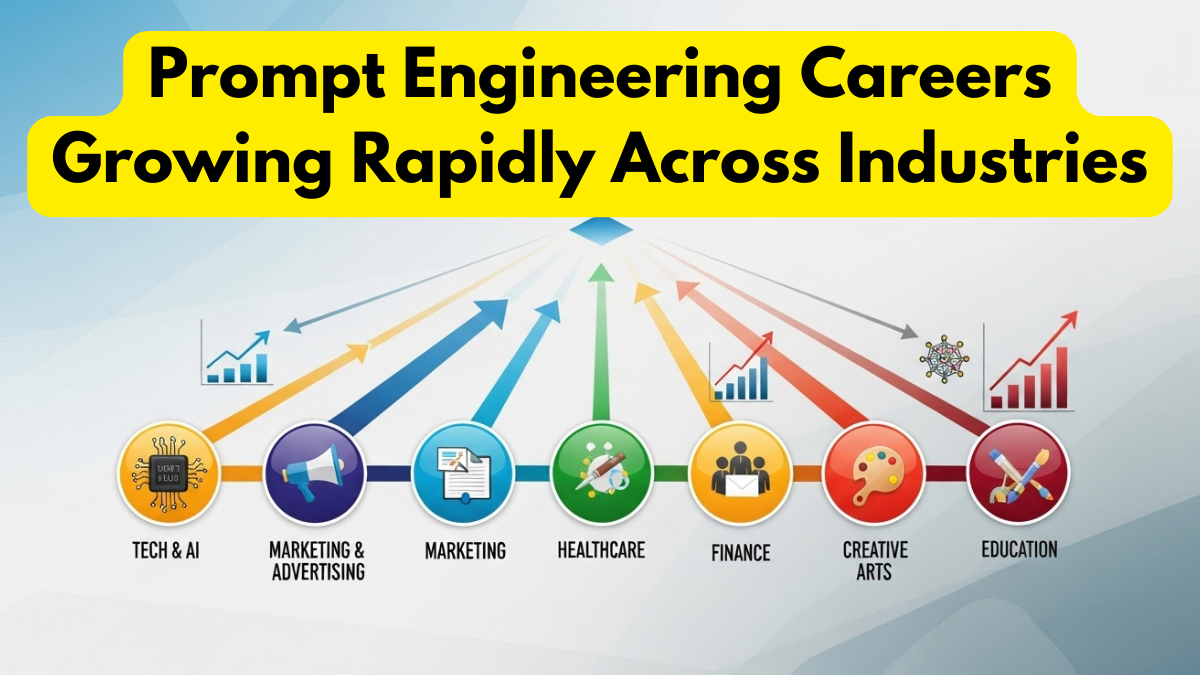
Key Industries Hiring for Prompt Engineering Careers
The table below highlights industries where prompt engineering careers are seeing rapid growth:
| Industry | Use Case | Role of Prompt Engineering |
|---|---|---|
| Technology | AI product development | Optimizing model interactions |
| Marketing and Media | Content generation and personalization | Brand-aligned AI outputs |
| Healthcare | Clinical documentation and analysis | Accuracy and compliance control |
| Finance | Risk analysis and reporting | Reliable and explainable responses |
| Education | AI-assisted learning tools | Adaptive and ethical instruction |
These sectors demonstrate how prompt engineering careers are expanding beyond tech companies into mainstream AI jobs across the economy.
Future Skills Driving Long-Term Career Growth
Future skills associated with prompt engineering go beyond immediate job requirements. As AI systems become more autonomous and context-aware, prompt engineers will increasingly focus on system design, governance, and oversight. Skills such as ethical AI alignment, cross-cultural communication, and strategic thinking will shape long-term career growth. Professionals who build expertise in prompt engineering can transition into roles such as AI strategists, product leads, or governance specialists. This flexibility makes prompt engineering careers a strong entry point into high-impact AI jobs that evolve alongside technology.
Challenges and Misconceptions Around Prompt Engineering
Despite its popularity, prompt engineering careers face misconceptions that the role is temporary or requires minimal expertise. In reality, effective prompt engineering demands deep understanding, experimentation, and continuous refinement. Another challenge is rapid technological change, which requires professionals to update future skills frequently. As AI models evolve, prompt engineers must adapt techniques and frameworks. Organizations that underestimate the complexity of prompt engineering risk underutilizing AI capabilities. Recognizing prompt engineering as a legitimate discipline is essential to sustaining quality across AI jobs.
The Future Outlook for Prompt Engineering Careers
Looking ahead, prompt engineering careers are expected to mature into standardized roles with clear career pathways. Certification programs, academic courses, and enterprise training initiatives are already emerging to formalize these future skills. As AI governance and regulation increase, prompt engineers will play a role in ensuring transparency, accountability, and responsible use. Rather than fading away, prompt engineering will likely integrate deeper into organizational structures, reinforcing its relevance across AI jobs in 2026 and beyond.
Conclusion: A Gateway to the AI Workforce of the Future
Prompt engineering careers represent a new frontier in how humans collaborate with intelligent systems. By combining language mastery, analytical thinking, and ethical awareness, prompt engineering careers are shaping the effectiveness of modern AI tools. As demand for AI jobs continues to rise, professionals equipped with prompt engineering expertise and adaptable future skills will be well-positioned to lead innovation across industries. In an AI-driven world, knowing how to ask the right questions is becoming just as important as knowing how to build the technology itself.
FAQs
What are prompt engineering careers?
Prompt engineering careers focus on designing and optimizing prompts that guide AI systems to produce accurate and useful outputs.
Why are prompt engineering skills important for AI jobs?
Prompt engineering improves AI reliability, safety, and relevance, making it a critical skill across many AI jobs.
Do prompt engineering careers require coding?
While coding knowledge can help, prompt engineering primarily requires language understanding, logic, and domain expertise.
What future skills are needed for prompt engineering?
Key future skills include analytical thinking, communication, ethical reasoning, and adaptability to evolving AI systems.
Are prompt engineering careers long-term roles?
Yes, as AI adoption grows, prompt engineering careers are expected to remain essential and evolve into strategic AI leadership roles.
Click here to learn more